
New York Central Railroad History
The New York Central Railroad was formed on May 17, 1853, by Erastus Corning through the union of ten preexisting companies. The early New York Central Railroad continued to grow and absorb additional railroad companies, until it had established lines from Albany to Buffalo.
In 1867, Cornelius Vanderbilt gained control of NYC, and the company was merged with the Hudson River Railroad— which Vanderbilt had acquired in 1864— to form the New York Central and Hudson River Railroad (NYC&HR) on November 1, 1869.
This merger brought Vanderbilt’s other lines— New York and Harlem Railroad, Lake Shore and Michigan Southern Railway (LS&MS), Canada Southern Railway, and Michigan Central Railroad— under the operation of the NYC&HR.
Continuing this trend of growth, in 1869, Vanderbilt commissioned John B. Snook to design his new Grand Central Depot, which would later be renamed Grand Central Station. Upon its completion in October 1871, its design and architecture were considered to rival those of European train stations; it was the first American station to receive such compliment.
With its many acquisitions and expansions, NYC&HR managed to overtake its competitors, perpetuating the company’s reach and success. In 1914, the subsidiaries (including those once owned by Vanderbilt: LS&MS, Michigan Central, etc.) merged with the NYC&HR to reform the New York Central Railroad.
It was referred to as the New York Central Lines from the time of the merger until summer 1935, when its identification became the New York Central System.
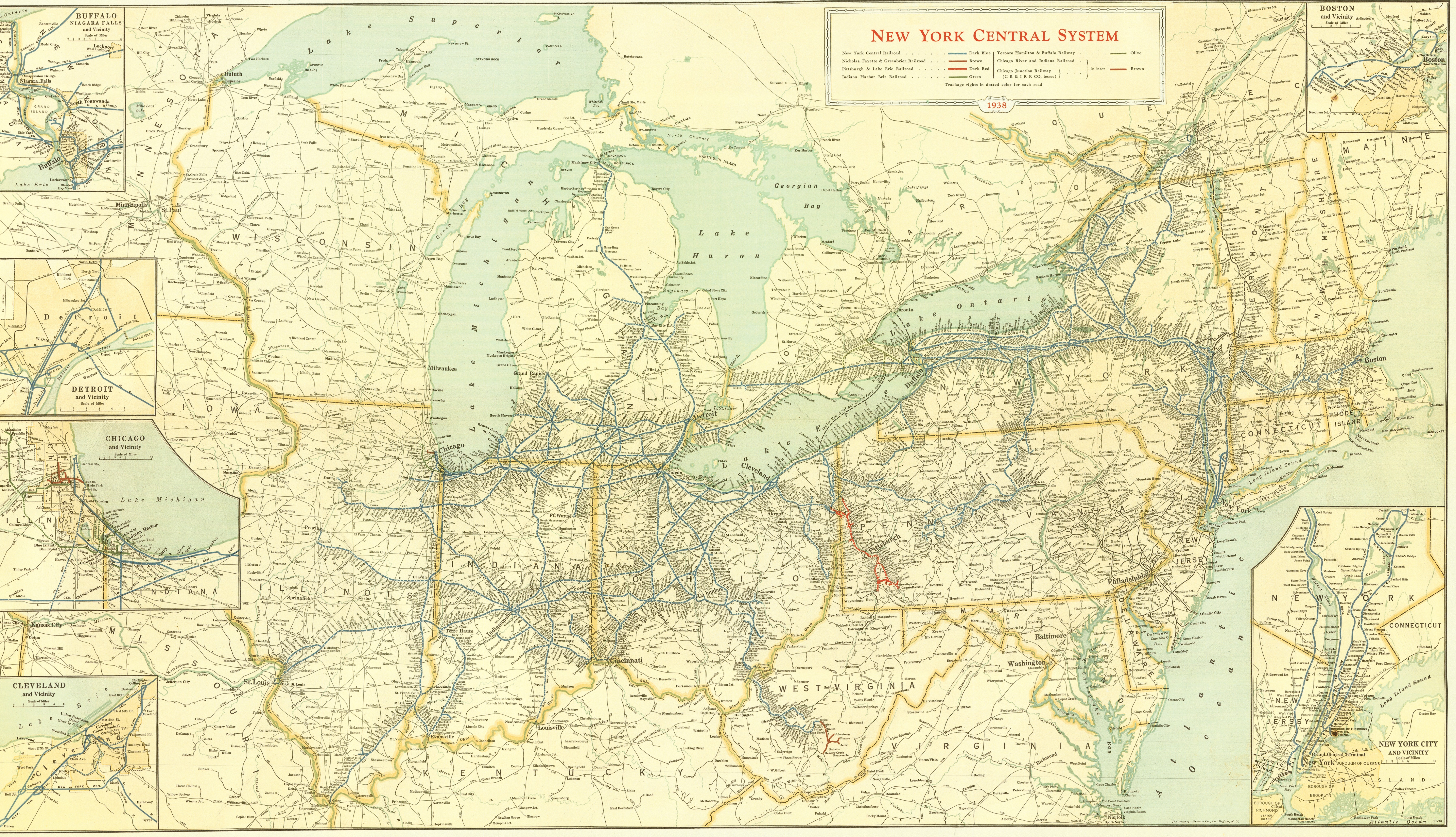
By the 1920s, the NYC would have over 11,500 miles of workable track, with lines stretching over half the continental U.S., making it the second largest railroad in the country. Its lines included such major connective cities as New York, Cleveland, Ft. Wayne, Chicago, St. Louis, Mackinaw, Montreal, and many others. Elkhart served as a vital link in NYC’s Water Level Route along the Lower Great Lakes, connecting New York and Chicago, east and west.
The railroad industry fell into decline after World War II, its financial problems exacerbated by the decline of passenger rail travel to the growing dominance of planes and automobiles. By 1955, NYC was considering a merger with its competitor, Pennsylvania Railroad, to relieve its financial stress.
The merger took place on February 1, 1968, forming the short-lived Penn Central, and marking the end of the illustrious life of America‘s second largest railroad.

Penn Central was formed from the merger of New York Central; Pennsylvania Railroad; and the bankrupt New York, New Haven and Hartford Railroad, which had been forced into the deal by the federal government. The new company proved to be generally dysfunctional, owing to conflicting operating systems, internal competition, and economic struggles.
In June 1970, after losing hundreds of millions of dollars, Penn Central filed for the largest bankruptcy in the nation’s history, remaining so until that of Enron in 2001. Penn Central’s passenger service was transferred to Amtrak on May 1, 1971; and on April 1, 1976, Penn Central’s freight operations were transferred to Conrail.
In 1997, CSX Transportation and the Norfolk Southern Railway (NS) agreed to acquire roughly equal parts of Conrail, taking over operations on June 1, 1999.
Today, the tracks that run past the museum are owned and operated by NS, as is New York Central’s Robert R. Young Yard—now Norfolk Southern Railway’s Elkhart Yard—the second-largest railroad freight classification yard east of the Mississippi River.
Contact Us
National New York Central Railroad Museum
nnycrrm.info@cityofelkhartin.gov
Phone: (574) 294-3001
Hours: Wednesday-Saturday, 10 AM - 5 PM EST